Česky

School
Science laboratory


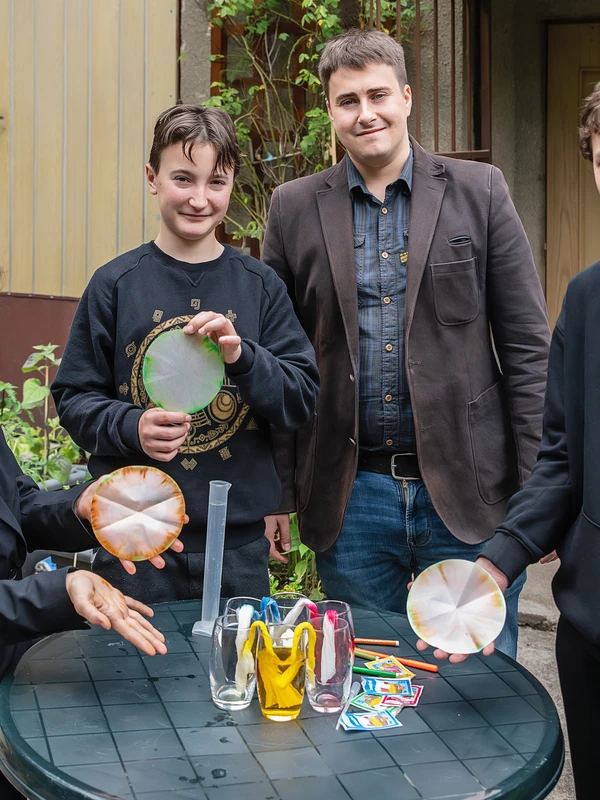

Exploring the world with all your senses
Our science laboratory offers pupils the opportunity to discover the laws of nature through experiments, observations and investigative activities. It is equipped with modern teaching aids and laboratory equipment, enabling pupils to gain an insight into the work of real scientists. The science laboratory provides a practical extension to lessons in chemistry, physics and biology, and helps pupils understand the subject matter – which in ordinary schools remains confined to the pages of textbooks – through the principle of ‘learning by doing’.
How a science laboratory enriches teaching
- Pupils can put the theory they have learnt to the test through experiments.
- We bring the curriculum to life with practical demonstrations in biology, physics and chemistry.
- Laboratory experiments and observations foster natural curiosity and an interest in the world around us.
- They are accepted into the secondary school of their choice, including prestigious grammar schools.
Observations and experiments in practice
In the science laboratory, we combine theory with practice. Teaching is experience-based and inquiry-led, in line with modern trends in science education. Pupils carry out biological, chemical and physical experiments, test the pH of everyday substances, and explore fermentation and chromatography. In biology, they monitor the growth of fungi from spores, observe chicks hatching in an incubator and follow the developmental stages of butterflies from egg through caterpillar and pupa to adult. They take part in long-term research projects, create mini-ecosystems and observe animals and plants. The laboratory provides a space for curiosity and for asking questions about how the world works, which helps children to better understand everyday reality.
Each experiment is designed so that children not only see how scientific principles work, but also get to try them out for themselves. As a result, they recognise connections and patterns, and learn naturally, with joy and curiosity.
Each experiment is designed so that children not only see how scientific principles work, but also get to try them out for themselves. As a result, they recognise connections and patterns, and learn naturally, with joy and curiosity.
Mathematics in Practice
In maths, we use magnetic fraction squares, which help pupils better understand the relationships between fractions, percentages and decimals. Fun logic and maths activities strengthen strategic thinking, accuracy and perseverance, and help pupils to solve problems effectively.
Physics in Practice
What equipment do we use?
Afternoon classes for the curious
The science laboratory hosts not only morning lessons but also afternoon specialist courses, which foster the children’s curiosity and practical skills and build on the work carried out in the science laboratory and the school garden. In the ‘Science in English’ course, pupils work with a native speaker to explore science in English, carry out fun experiments, expand their vocabulary and, in the process, deepen their theoretical and practical understanding of natural phenomena. The science seminar provides scope for independent projects, systematic observation and experiments. Pupils can monitor the development of animals, grow plants and carry out a wide variety of experiments in the laboratory.
Both courses encourage independence, creative thinking and teamwork, and help pupils to see science as a natural part of everyday life.
Find out more about the afternoon courses
Both courses encourage independence, creative thinking and teamwork, and help pupils to see science as a natural part of everyday life.

Would you like to know more?
Please get in touch and we’ll arrange a meeting where we’ll provide you with more detailed information about the school, teaching, lessons, teachers and much more.
Arrange a meeting

Types of spaces
School premises